


60-day money-back guarantee. If it is not right for you, send it back.
Find the failing cell before it finds you.
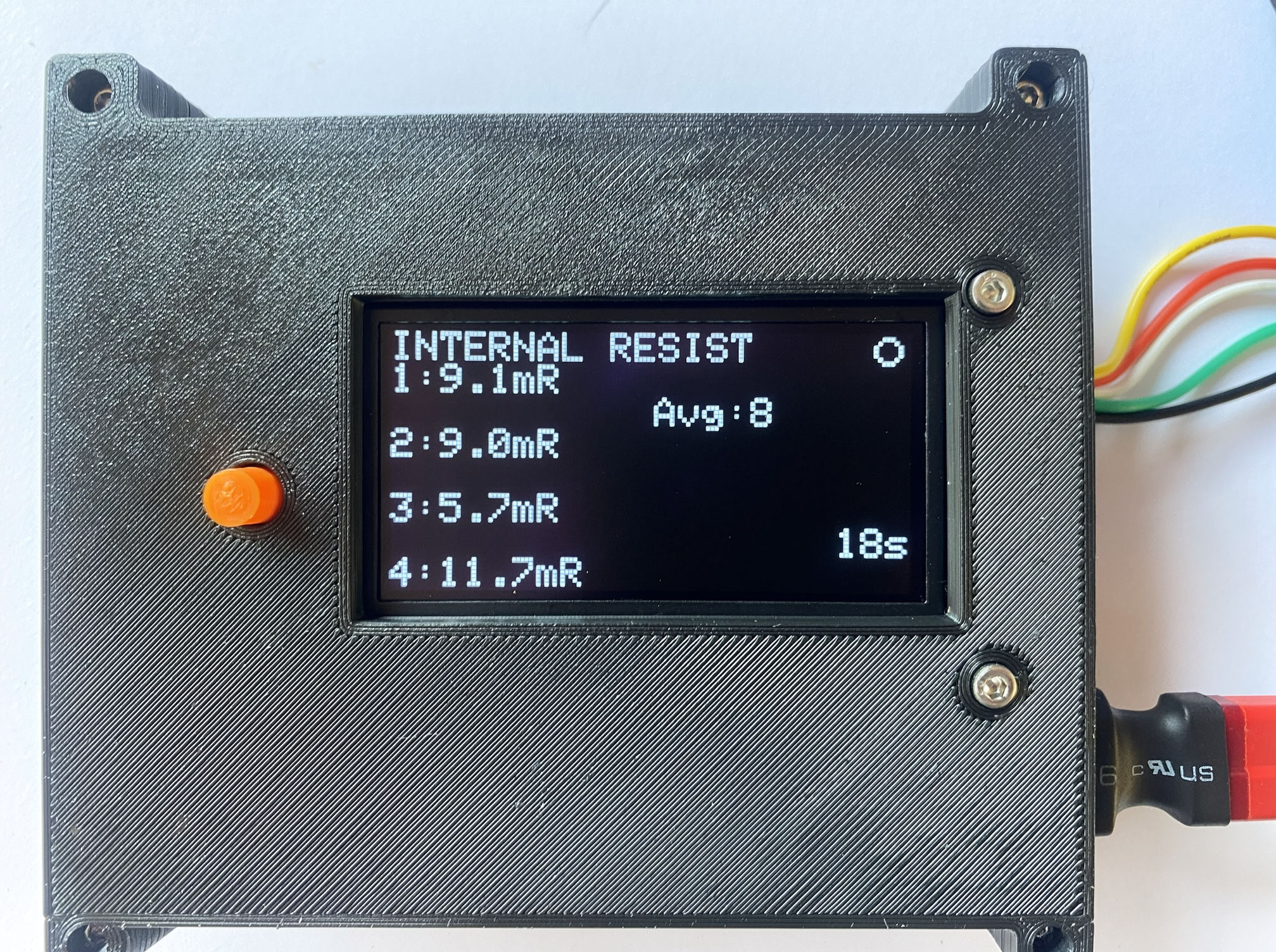
Battery Guardian measures internal resistance on every cell in your pack through the balance lead, without probing cells one at a time, and keeps the history so you can watch a pack age instead of guessing.
What it fits
2S, 3S and 4S packs. LiPo, LiPo HV, LiFe and Li-Ion.
Balance lead plus XT60. There is a dedicated socket for each cell count, so a plug cannot be seated one position off.
5S and larger are not supported on this board.
Two connections, one button, and every cell reported separately about seven seconds later.
Battery Guardian: LiPo Internal Resistance Meter and Cell Checker
Battery Guardian applies a real load and measures what your pack does under it.
When you start a test, the board switches a 20 ohm resistor across the pack, drawing roughly 870 mA on a fully charged 4S. It measures each cell's voltage at rest, then again under that load, and divides the sag by the current. That is internal resistance, measured rather than inferred.
The load stays on for about three and a half seconds, and the reading is taken at a fixed instant inside that window. That fixed instant is the part that matters, and it is why a reading from this board means something a single number from a bench meter does not.
A cell's apparent internal resistance climbs the longer current has been flowing. So a meter that samples whenever it happens to settle gives you a number that depends on when it looked. Battery Guardian looks at the same point in the same pulse, every time, on every cell. Two readings taken six months apart are answering the same question.
Battery Guardian grades each cell against bands that scale with your pack's chemistry and capacity, because a 5000 mAh pack and a 1300 mAh pack are not expected to read the same.
LiFe packs need a C rating before they can be graded, because LiFe construction classes differ enough that one set of bands does not fit them all. The app will ask you for it.
Li-Ion packs are measured but not graded. You get the numbers for every cell and the history, but no verdict, because we do not yet have band data we would stand behind for Li-Ion. We would rather withhold a verdict than invent one.
Where the bands come from. They are drawn from RC practitioner consensus across multiple independent sources, not from a single blog post and not from a laboratory study. They are a guide for deciding when to retire a pack. They are not a clearance to fly, and this board will never show you one.
Android companion app, free, no account, no cloud, no subscription.
It is not on the Play Store yet, so you install it yourself. The download is at the bottom of this section.
What it does. Every test is stored against a specific physical pack, using the pre-printed tags in the box. Readings are never pruned, expired or thinned out, and there is no limit on how many tests a pack can carry. It charts your readings over time and exports the lot to CSV.
It refuses to mislead you. If we change how the board measures, the app will not plot a trend across that change, and it tells you in plain words why a reading was left out. Old readings stay listed, never hidden, and never silently mixed with new ones taken a different way.
What it does not do. It does not predict when a pack will fail, estimate remaining life, or fit a curve to your data. It plots your readings and joins them. You make the call.
It cannot phone home. The app ships with no internet permission at all. Not disabled, not opt-out: the permission is stripped from the build, so the app is incapable of making a network request. You can verify that yourself.
Get the appDownload the Android app (APK)
When prompted, allow your browser to install apps, then open the downloaded file. This is normal for apps outside the Play Store.
Or open on your phone: dl.flyingtigerrc.com/battery-guardian.apk
Assembled and verified by hand, one board at a time.
Every production batch is calibrated against a reference meter using a documented procedure with a fixed pass gate. Each individual board is then verified against its batch before it ships. A board that disagrees with its batch is investigated, not quietly adjusted to match.
The board is the instrument. The app is the logbook.
Battery Guardian has a 2.42 inch display and a single button. Plug in a pack and it shows live pack voltage and every cell. Hold the button and it runs a full test and shows you the result, right there, with no phone involved.
What the board cannot do is remember. It holds your most recent test and a power cycle wipes it, and it has no idea which pack is which, aside from cell count and chemistry selected at boot. That is what the app and the tags are for.
Unplug your pack when you are done. Battery Guardian is powered by the pack under test through the XT60. There is no power switch. Plugging the main lead in turns it on and unplugging the main lead is the only way to turn it off.
Pulling the balance lead does not turn it off. No power reaches the board through the balance connector. A board left with the balance lead out and the main lead still in keeps running and keeps draining your pack.
A pack left connected overnight will be over-discharged, and on a 4S that means scrap. The board's own cutoff sits far below the point where a LiPo is damaged; it protects the board, not your battery.
Seat the balance plug fully, in the socket that matches your cell count.
Do not run tests back to back. Give the board a minute between tests. The load resistor gets genuinely hot during a test and there is no temperature sensor and no enforced cooldown, so pacing it is on you. It can handle a few tests back-to-back, this warning is just for your safety. We have had no issues with back-to-back testing on our bench.
Orders ship within 48 hours, Monday through Saturday.
60-day money-back guarantee. If it is not right for you, send it back within 60 days of delivery, no questions asked. Email sales@flyingtigerrc.com and we will sort it out.


